
The Glyphs
ENTRY ID:
SUBJECT:
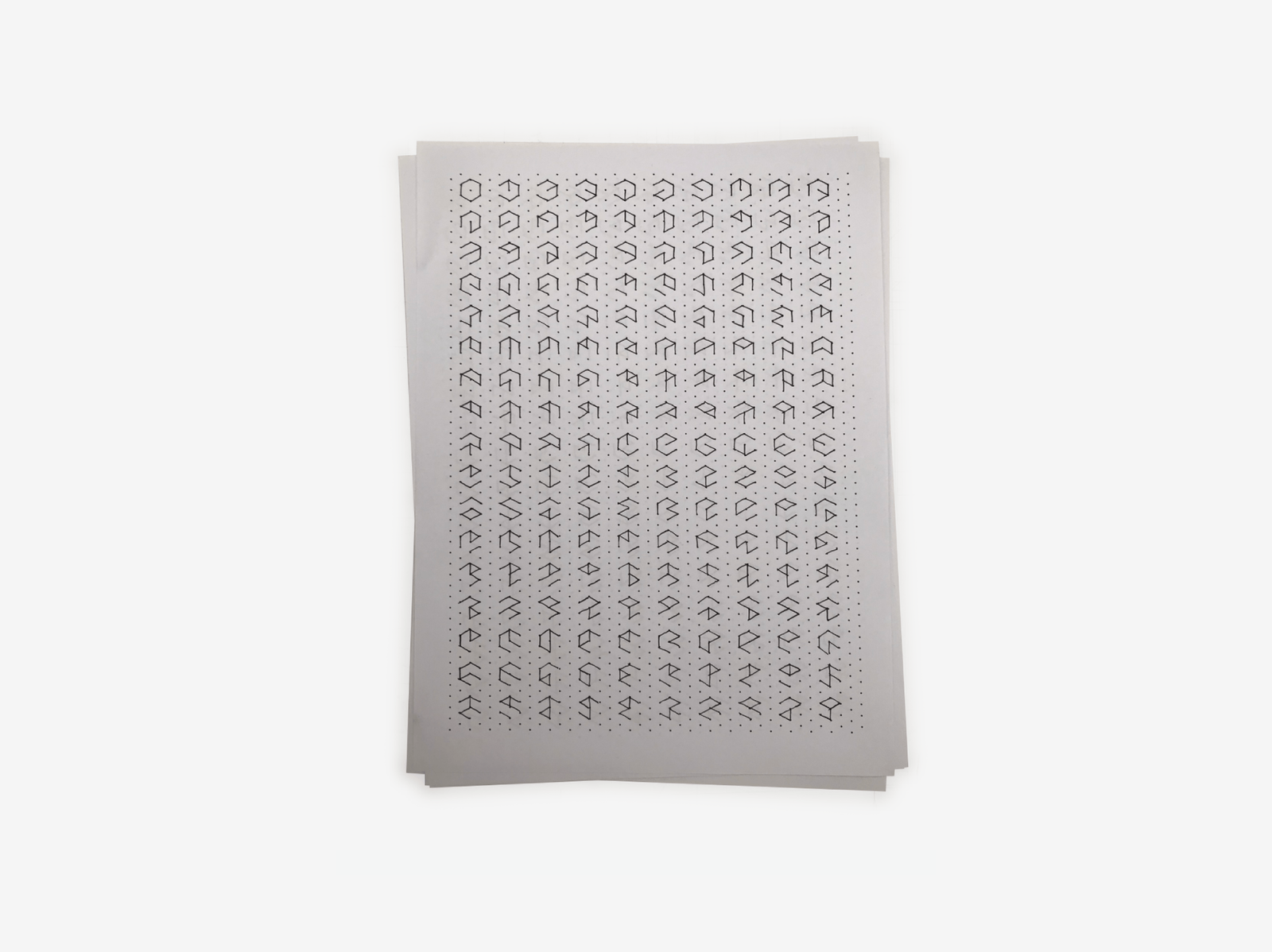
A recent discovery, delivered by the Folio, are the Glyphs.
They number 924. They are hand-drawn on plain white paper, which appears to have been pre-printed with an isometric dot grid, perhaps specifically for this purpose.
Other than the glyphs themselves, there are no markings on the pages. The glyphs are not categorised, nor do they carry any reference or coding. There is no indication of their intended purpose or origin. It is my assumption, as with everything the Folio gifts me, that they are the work of Professor Morozov.
I have spent a number of weeks attempting to trace the origins of the glyphs. My first instinct was to compare them with known scripts: alphabets, runes, ideograms. I cross-referenced with as many ciphers as I could locate (Greek, Ogham, Norse, Mayan, and others). I found not the slightest match. They do not appear to be phonetic; perhaps they are mathematical or structural.
The hexagonal structure led me to research hexagonal tilings, which recur in both natural and human systems: honeycombs, molecular lattices, mandalas, Islamic tilings. Again, while similarities exist, no clear connection or corroboration emerged.
After a brief foray into calendrical systems, I sought clues in the physical sciences. Hexagonal lattices are ubiquitous in materials such as graphite, quartz, and ice. Perhaps the glyphs encode some kind of atomic structure or crystallographic key?
I even consulted star charts, searching for a connection with visible constellations, but without success. At last, I felt I had exhausted all attempts to trace their origin, and I must assume they are unique.
I began instead to analyse the glyphs in more detail.
There does seem to be a deliberate order, with specific groupings. There are ‘rules’ in their formation. Each glyph is composed of six marks drawn from twelve possible positions around a hexagonal lattice.
Of the 924 raw forms, they can be reduced to 160 unique glyphs (discounting rotation) or 90 (discounting both rotation and reflection).
- Symmetry within the system is rare.
- The vast majority – over eight hundred – resist both reflection and rotation, bearing no harmony but their own.
- A small group of eighteen show a two-fold balance.
- Only four carry a three-fold balance.
- Two solitary glyphs use the full six-fold order, each identical under every turning and reflection.
It is clear the system is not arbitrary. The lattice and its reductions bear the stamp of a deep geometry. Whether these forms are to be read as language, as index, or as key, I cannot yet say—but their origin lies not in ornament, but in law.
Related Records: